Balancing the Scales
How UK Retailers Can Win for Both Business and Employees
Margins are tighter. Customer expectations are higher. And frontline employees are caught in the middle.
UK retailers are asking stores to “do more with less.” At the same time, they know they must address attrition, engage employees, and attract a new generation of talent. The question is: can business performance and employee experience thrive together, or does one always come at the expense of the other?
On Wednesday, 5 November, join Michael Spataro, Marcus Beaver, and Rob Bate for an interactive conversation on the future of UK retail workforce strategy.
Together, they’ll explore:
- What’s driving the widening gap between business needs and employee expectations
- How AI and modern workforce management can help close the gap—while highlighting the critical moments where human leadership makes the difference
- Practical steps UK leaders can take now to improve both performance and retention
It’s not a choice between profit and people. It’s about unlocking the strategies and tools that allow UK retailers to win on both sides.
Transcript
Michael Spataro
00:10 - 00:35
Good afternoon, everyone, and welcome to Balancing the Scales, How UK retailers Can Win with Both Business and Employees. I'm Michael Spataro from Legion.
I'll be joined today by two people who spend their days helping retail organizations in The UK and The EU navigate exactly these challenges. Marcus Beaver, strategic adviser for Legion.
Marcus Beaver
00:35 - 00:48
Afternoon, everyone. Good to have you all joining us.
Looking forward to explaining the next forty five minutes, sharing my experience that I've garnered over the last twenty five years and four months into Legion.
Michael Spataro
00:48 - 00:54
Thank you, Marcus. And Rob Bate, CEO and cofounder of FrontlineXP.
Rob Bate
00:54 - 01:01
Yeah. Thanks for the time today.
Really looking forward to the conversation. Quite timely one as well, so I'm looking forward to getting into it.
Michael Spataro
01:01 - 02:51
Okay. So before we get started, let's go through some housekeeping items. Please feel free to use the Q&A box throughout this today's session. We'll be monitoring the questions and weaving them into the conversation. If we don't get to your question, we will follow-up afterwards. If you have any technical issues during the call, drop a note in the q a box, and our production assistant will help you directly. A replay of today's webinar will be available and sent to your email so you can revisit or share with colleagues. Finally, at the end of the webinar, we'll be drawing one name from the raffle for a gift card. So please stay till the end.
Now that that's out of the way, let's start with reality.
UK retail jobs have fallen to their lowest levels on record. Margins are tight, expectations are high, and teams on the floor are being asked to do far more with less.
At the same time, leaders know they can't afford to lose their best employees. They need to engage and retain them even while pressure mounts.
That's the question at the heart of today's discussion. Can business performance and employee experience truly thrive together, and does it always have to come at the expense of the other? We'll explore what's driving the gap between business and employee needs, where AI and modern workforce tools can help, and how leadership can make the difference.
Let's dive in. Marcus, I'd like to start with you.
What do you think is driving the widening gap between businesses, business needs, and employee needs?
Marcus Beaver
02:51 - 04:46
So I think to start with, I think we all know businesses are under pressure. It doesn't matter what sector they're in, what size they are.
I think over the last five to ten years, we've seen some incredible high street brands disappear. They've disappeared from the high street. They've disappeared from retail parks. Some have reappeared online. And we're seeing businesses needing to respond to changing, you know, kind of consumer demands. So pressure on margin, there's pressure on productivity, pressure on efficiency. Don't get me started on, you know, increasing legislation, increasing compliance needs. You know? It all just kinda builds.
So I think for the managers, I think that's kind of the first area I'd look at for businesses. And let's face it. They've got all of the pressures that their employer is dealing with, and then they've got to deal with, you know, managing their employees. They've got to cope with the glorious British weather, which, you know, in York, you know, this morning, it was trucking it down this morning. It's kinda bit grey and dismal. You know, they've got to cope with unexpected roadworks. They've got to cope with, you know, cheap strikes and maybe a cheap strike that might, you know, start again or stop again at the last minute. It's a huge amount for them to cope with, and we're asking, I think, as businesses, managers to be able to cope with all of these variables and quite often at short notice without access to the data, without access to tools to analyze it, and then asking managers to then communicate with employees.
And quite often, we're asking them to do all of this with, you know, enterprise tools like Excel and WhatsApp, and it's just not enough. And then I think, you know, employees are then sort of saying, well, hang on a minute. We want a different experience. We want to get it controlled when we work, how much we work, how often we work.
That all kind of builds to quite a big attrition, I think, and, you know, a lot of cost to businesses. So I think if businesses could address those two issues for the managers and employees, I think we'd see businesses, you know, kind of addressing a lot of the challenges they face at the moment.
And, obviously, we have a budget around the corner to deal with as well.
Michael Spataro
04:46 - 05:11
So it sounds like, you know, what you're saying is, retailers really have to focus on, really balancing their business needs and with an equal focus on employee engagement, which is a struggle in today's world.
Rob, from your perspective working with, with frontline leaders, how is this gap showing up in the store and on the sales floor?
Rob Bate
05:11 - 07:33
Yeah. You know, it's a really good question, and there's probably a thousand ways I can answer it. There's probably two things or one thing that I come back to all the time. And it some of it is about my experience with retailers centrally and from a consulting point of view. But also when I was out in stores, I used to be a a frontline leader or a store manager back in the day.
And the one thing I would say keeps coming back to is this difference or mismatch between what the central teams are focused on and and would like to happen versus the reality of what store teams face on a day to day basis.
And if I put that into sort of two buckets, I guess you got got one where, you know, central teams are trying to drive efficiency. They're trying to drive, you know, best fit to plan. Central store teams want simplicity. They want, straightforward workflow, they want to know what they're doing next.
And in another bucket, you have central teams focusing on a different priority every week that, you know, typically, they're relatively small sort of central teams that can pivot from sales to cost saving, you know, relatively quickly in light with what leadership want.
Stores can't really do that. They're focused on and want consistency. They want predictability. And more importantly, in the point that that was touched on a second ago, is that the people are really central to that, and they rely on those people to work the shifts they want them to work and do a good job when they are at work and know how to execute really well. You can only do that if you're giving people consistency of message. Otherwise, people don't know whether they're coming or going, and that drives a bit of a distrust.
And there's probably that overarching, you know, piece here about you know, when we start talking about technology and the deployment of that is change management's really important, and therefore people at the center of that to make it land is really key. And something that used to drive me absolutely insane when I was a store manager was not just the difference in what central team wanted versus what we could actually execute on the sales floor. It was when technology was an additional thing on top of what we were doing. So very rarely was capacity created for change, very rarely was something taken away to bring in a new technology or a new process. And, actually, I think that's probably what drives a lot of the mismatch between what's planned and what's executed, and that can drive a lot of frustration in both directions.
So but if I summarize it, I'd say both central teams and store teams are they're reading from the same book, but they're either in different chapters or on different pages.
So they're not completely misaligned, but the continual change of direction and stores not being able to keep up is probably the principal issue of what creates that gap in my view.
Michael Spataro
07:33 - 08:47
Yeah. So it sounds like the real change isn't effort. It's that alignment, and helping the hourly worker and the store manager understand what's really important to the business. I also heard you and Marcus talk a little bit about in the past, it was really about how do we create the best experience for our customer. And sometimes that would be at the expense of the employee. And in today's world, both are critically important, and you can't do one without the other.
We also need to ensure that there's clear communication, better alignment, and less confusion. Businesses are asking for increased output without necessarily equipping the teams with tools that maximize their efficiency. So let's talk a little bit about technology and how that fits into the equation.
Marcus, you work closely with retailers using AI to optimize forecasts, scheduling, and productivity. What's one misconception you still see among UK leaders when it comes to AI and workforce management?
Marcus Beaver
08:47 - 10:55
Just before I get on to that, I was just gonna mention, Rob, you you referred to change management there as well, and and I think, you know, you and I both receive, you know, calls, emails, RFPs from organizations in the market looking to address these challenges, and quite often, change management just doesn't appear. And I do think just to kinda link that through to some of the kind of misconceptions, one of the misconceptions right here and now is that you can deploy this technology without enough change management.
And quite often, if there's a bit of the budget that gets cut, quite often change management gets reduced up down to training, and it's just not enough. But I think kinda more widely, based on the conversations I've had over the last couple of years, quite often, retailers are looking to address a lot of their challenges by looking at the HR and payroll systems, and they start there, they quite often invested millions and months, years, in the likes of Oracle, Word, ASAP, etcetera, and they kinda start there.
And then they can actually lose a lot of time trying to get their HR and payroll system to deliver scheduling and productivity. And those platforms are very good at what they do, but they don't tend to be very good at that, which is why there's a whole industry of kind of best of breed vendors like ourselves that do this.
I've also seen a lot of retailers, using a lot of old legacy systems, and they spend too long trying to get those to work and bolting stuff on. And then you end up with even more siloed systems, and it's either a massive headache for IT or it's a massive headache for the managers.
So I think quite often, having one solution that perhaps doesn't do everything is better than having lots of solutions that have all the bells and whistles, and and I think that's kind of the trade off. But I think if you can focus on the employee experience first, then you're starting from the right point.
And then I think in terms of kind of, we've mentioned the employee experience. We've also gotta make sure the operations teams get access to this kind of technology as well.
There's obviously a lot of fear and mistrust around AI. But I think if we can if we can give employees their experience that they're getting outside of work, inside work, and do the same for managers and ops people, we'll go a long way.
Michael Spataro
10:55 - 11:26
Thanks, Marcus. Rob, from your experience, where does technology genuinely, help the frontline? Where can it actually, and where can it actually create friction if not implemented thoroughly? And, additionally, do the frontline workers, whether that's managers or employees, really understand AI and how they're using that today and how it's benefiting them today? If you can touch on those couple of points, that'd be great.
Rob Bate
11:26 - 15:13
Yeah. Yeah.
Sure. And if I don't hit the point, pick me up on it.
So I think technology in and of itself I mean, back to the point that was made earlier, actually, I have this firm belief that technology in and of itself is is really only gonna make things faster for the most part, and we were expecting a business improvement. We're expecting output. We're expecting, you know, more money in the cash registers or money saved on the balance sheet through better labor spend. It comes down to a behavior change of a person doing something differently. You know? And the technology is gonna surface insights. It's gonna provide more data. It's gonna maybe even gonna get guide the decision, the next best action that's gonna lead to that outcome.
It's all possible without technology, but it's much, much harder. You know? And the decisions tend to be a lot simpler and not as precise. So it really comes down to, there has to be a person that we're trying to impact here positively.
And for me, that's where technology really can help make things quicker and simpler, but it's also gotta be paired with there's some really good leadership about how we want people to change what they do. But also process improvement is a really key thing if we just bring technology on top of the process everyone already finds frustrating.
And, also, they don't follow. You know? It's one of the biggest issues I hear from ops teams is we wish stores would do the thing we want them to do when we want them to do it. But if you make it really simple, it's a lot easier to do that. When there's 50 steps and four systems and 15 clicks, the chances of that being followed are next to zero, and we wonder why. You know? And going to market for a technology, we think we'll solve that with a silver bullet approach. It tends to actually make it, you know, even more difficult.
So I think that's where the bad friction can come in. With the best of intention, it's, hey. We've got a brand new tech, and it's gonna work like this. And everyone's like, well, it's not any better than what we had before. In fact, it's harder than you know, you kind of know you missed the steps. So I think it has to come down to what's the experience we're trying to impact and who we're trying to positively impact.
And in my view, I think the thing that I come back to again and again about where these sorts of challenges can be avoided is when businesses just spend time with their teams out on the floor. Is the reality of what we plan and budget for, are you able to execute against that?
Back to that example I mentioned before, it's spending time with the store teams, What gets in your way? What prevents you from doing this? If we were able to provide a technology that could surface a signal for you to do something before the end of the week to take action, would you take action? You know? You want your sort of teams to go, no, I would ignore it. Okay. Why would you ignore it? What's difficult about and several amount on the floor if I can't keep running back to the back shop to see an email? You know? So they're looking for some sort of technology perhaps that's gonna be in their hand, you know, but at least you've got then a better idea about how you could create a solution that's gonna fit the workflow, and therefore, the person is gonna find, a positive experience around and be receptive to. And if they do that, they'll follow exactly what you want. It's when things are hard, stores always find a shortcut, and it's a shortcut that makes life easier for them. So if you can align to that, you're pretty much in good shape, and that's where the goal is, honestly. You know, speaking to stores, they feel engaged.
They feel part of the process. There's no surprises when a new technology comes in because they're fully expecting it, and they're giving you all of the stuff from a central point of view you can't see.
And that's where AI is really, really strong. It's gonna help, automate tedious steps that nobody wants to do anyway, number one.
But number two, that it's the data and the signaling. But the managers still have to act.
It's all well and good. They're saying, you know, before the end of the week, sales are looking like this, and, there's some challenges around schedule cover on Friday. Here's option one, two, and three. But if the manager just ignores those options because they believe it or they weren't engaged, they don't know why they're getting those three or four options to choose from. They're just gonna ignore all of them and do what they did before. So it's getting those store teams involved in the decisions and the transformation, basically, is how I see the things playing out for the best.
Michael Spataro
15:13 - 17:37
Yeah. So, I mean, I think I think both of you hit on some really, really key points.
And interesting how these, you know, the first topic we discussed and the second topic kind of blend together. Right?
So what AI can do is help reduce some of that friction, right, so that employees and managers are doing less of the routine mundane tasks, and focusing more on what's important to the the important to the business.
So reducing some of that friction, maybe improving some of that alignment, so that the tools are helping them to make the best decision instead of trying to figure out what the best decision is.
So but I also wanna tie in, Marcus, your point about about change management that it's really important for, employees and and and managers to really understand how AI is actually helping them today, and how it's gonna continue to help them to be more focused on what's important to the business and driving that right customer experience. There's that fear that AI is gonna replace humans. I think AI augments what work that a human has to do.
You're always gonna need humans. I like the tagline that AI should be bringing more human interactions to human interactions.
That hourly worker can spend more time with the customer because they're spending less time on routine, mundane tasks. There's reduced friction and there's more alignment.
Great. So let's move on, as, I think this is a great conversation and these topics are really blending into each other.
I think that trust is key. Right? So it's a great segue into the next topic.
Peak season when pressure is highest, sales goals, scheduling gaps, customer demand. During this high pressure time, what are some of the most important leadership skills that you've seen make a difference when it comes to teams being stretched thin? Rob, let's start with you on this one.
Rob Bate
17:37 - 20:00
Yeah. So, I would say, I've been in the space a long time now, about twenty years, so I'm probably giving my age away or dating myself a touch.
But, listening to employees is probably the key, especially during those peak periods where, most stores and businesses and retail are about to hit this really big peak. That's you know, it's important for their top line. It's important for their bottom line, but, you know, they're gonna have lines going out the door. They're gonna have customers complaining about various things.
Just listening to your employees and playing back what you can do for them, what you can help them with. And that's from a central point of view to a store team perspective.
Also within stores, managers want to be spending more time with their employees and helping explain why the schedule looks the way it does, be able to accommodate shift swaps and pickups and explain to people why is the business, operating the way it is so they can just kind of feel part of the process and not, have this sort of dictatorial feel about it. I think that's a really important point.
I think also asking, I suppose not just expecting stores to execute, I guess, is probably the simplest way of putting it.
Central teams are great at coming up with new protocol, new communications, new SOPs, routines.
But unless they're saying, and here's why we need to do it. Here's what we're expecting it to look like.
Give us the feedback if it's not right. You know, all this kind of feedback loop really needs to be there to drive any sort of improvement, and in creating the time and capacity, especially during that peak period.
If you're not doing that, we're just expecting stores to figure it out, you know, which some do and some don't, and that's why we have this perpetual challenge in ops going, why do we want one store that performs so differently to the other even though they have the same SKU, the same square footage? We've got back manager, good manager. I thought, well, no.
We're creating that variance by by letting them figure it out without guidance, without data, and without, coming back to the AI point, without giving them that access to tools and technology like AI to kind of assist them and signal that things probably need looking at before they have an impact. Because we often do that, don't we, in central teams, in central business teams is we will look back at last week's report and try and figure out what happened.
The answer's not there. The answer's in the week coming up, the quarter coming up, the month coming up. That's where we can help. That's where we can impact.
It's not a good use of time to be looking back at last week and what got missed. The benefit is helping stores go, you know, look forward into the future is kinda how I see it.
Michael Spataro
20:00 - 20:25
So I think I hear well, I think what I'm more of hearing you say is is engage, like, stores in the process. Help them understand why you're asking them to do the things that you're asking them to do instead of just telling them what to do.
What are you seeing from retailers today who get this right, who can really deliver strong results while keeping their people engaged. What does that look like?
Rob Bate
20:25 - 22:48
It's gonna be difficult for me to name specific names, but there are some businesses out there that I think do this really, really well. I'll chuck it out there. Why not?
So Costco is a really good example. You could argue that a business model is relatively straightforward. It's not as complex perhaps as a high street retailer and the challenges that they have, but, actually, they've gone for simplicity as a model, and that makes communication very straightforward. It means asking more of the workforce is very straightforward. People know what to expect. And because they don't have millions of moving parts just to operate in the day to day, It means making changes is actually very quick. It's very effective. It's quite easy to see where change and adoption hasn't taken place.
So just that model of simplicity and taking, effectively, taking work and steps out of day to day operations is actually a really easy way to win because it takes the load off of everybody. So I probably won't say it's a sort of gold standard of, maybe what folks should, should go for.
But there are some high volume grocers like Wegmans, for example. They've really focused on employee experience and being more employee centric just in their nature and since how they communicate that feedback loop that I spoke about.
They really did a good job of implementing that. And there's several retailers in The UK that I know plan. I met one last week, actually, and did a post about it, and they actually spend time with the stores to look at how their forecast and demand processes actually impact stores to see if they're in a position to execute based on the budget they give them.
So they don't just create it centrally, hope for the best, create schedules from it, and then complain about it afterwards.
They create their budgets. They go out there before they execute on the budget, and they speak to those still managers and go, here's what Christmas looks like. Here's what Christmas week looks like. Can you work with those numbers? Do they how do they compare to last year? How do they compare to what you're planning for? They're actually having that discussion ahead of the execution week, and they get chance to adjust it based on feedback. Right? So but it's all part of their nature. Like, they're trying to be more employee centric and look at the execution rather than the sort of science, if you like, of forecasting demand as a discipline. They're trying to hook it together as an end to end process.
Because if it doesn't execute, the stores just end up overspending or underspending, which then drives that service impact you mentioned. So there's some really good examples out there. There are many more, I'm sure, but those are the ones that come to mind for me that I have had some connection with, in the recent past.
Marcus Beaver
22:49 - 23:32
I was just trying to say, Mike, I was at a conference a couple of weeks ago. You know, I have a lot of leaders out there at, you know, these events looking for those good ideas and sharing knowledge, but it did feel like it whether it was a lot of, you know, AI is the answer.
What's the question? And I think, you know, we just gotta be really careful that we're we're not seem to be just, you know, pushing a technology answer out in into, you know, into stores, into operations. We've gotta be looking and saying, okay.
You know? We all know when we go online and look at, you know, a review, we're now getting an AI summary. Right? It's getting more acceptable.
It's out there, but we're not having it pushed to us as AI. We're having it pushed to us, here's something that helps you.
And I think that's gotta be the angle, you know, all the way back to, you know, the change management approach to it. Those em dashes more tech.
Rob Bate
23:32 - 24:28
Those em dashes, Marcus. That's what I'll get you.
And, yeah, I absolutely. You know, AI will not fix culture, and it will not fix trust issues.
It will create time to fix those issues. But you gotta
You gotta and I have had this you know, I will die on this hill. But where I hear businesses, not just retailers, but, you know, in other industries say, I want AI to save me time so I can, for the most part, you know, save money on the labor budget and exit people.
Like, why would you want to do that? If you can now quantify all of this time, your challenge is how do you turn that time into customer facing time, things that actually matter.
And to answer that question, you've gotta get into, well, what goes on in my stores and in my business that actually matter to the customer? And I'll be honest, some people don't know the answer to that.
It's like, well, go find the answer before the first thing you go to is now I can run my store with fewer people. What makes you think those people that remain are gonna want to stay there?
Michael Spataro
24:28 - 26:21
Yeah. Well, it's interesting how all of this kinda comes together.
Right? You we we, you know, we started out the conversation talking about, you know, the doing more with less.
Right? And then we talked about the friction and the misalignment.
And then Rob, I think you've brought in a great point. Like, whether it's Costco or, Wegmans in both of the you talked about simplicity, which doesn't mean that every retailer should look at how to simplify everything they do.
But by leveraging AI to reduce some of that friction, right, and to build some of that alignment, you are simplifying your overall operations so that people have, as you said, more time to spend with the customer. As we're talking about people in the last couple of minutes that we have, let's really talk about that next generation.
So, as we look forward, as we know from the annual state of the hourly workforce UK edition, The next generation of retail workforce and when I say next generation, that doesn't mean age related. Right? That next generation is really multigenerational.
There are baby boomers that are, you know, coming into the workforce for the first time because they want a side job, then there's the gen x that's getting their first job. So there are a lot of, you know, how do we manage all of those generations in one in one environment? So based on our research, this group, right, that broader group really values, flexibility, purpose, and autonomy more than ever before.
How should that reshape the way UK retailers think about their overall workforce strategy? And, Marcus, why don't we start with you?
Marcus Beaver
26:21 - 28:12
Personally, I think, controversially, one of the first thing I'd do would take all those labels off Gen z and baby boomers and what have you and and just kind of look at the how we sort of segment that workforce. You know?
Is it, is it an individual that's returning to work at a different stage in their career for whatever reason? You know? Maybe you're returning from maternity leave or maybe they've come out of corporate life and looking to have something meaningful during the day and wanna go back to work.
You know, a family friend had a very senior job in IT and now enjoys working on the tools in m and s. That gives him, the meaning, you know, meaningful day and weekend that, you know, that he wants. At least that's what he tells him anyway. So, you know, I think we've got to look and listen to the data.
Right? Look at it. We've got a new report coming out soon, but, you know, what it's telling us is one size doesn't fit all, and we can't just put it into age brackets.
We've gotta look at what does the employee want, why do they want it. And you're absolutely right, Michael, that the data tells us the research tells us that, we've got to put more empowerment into the hands of the employee because if we don't, then they will leave.
And they're telling us they're not leaving for a couple of pence more on the base salary. They're leaving because they can't get the shifts they want, when they want them, where they want them, etcetera.
And so they're doing this offline with friends and colleagues almost like outside of the, you know, the corporate process, and it just gets too hard. So everybody's had those blanket emails, blanket WhatsApps, and it's just not what the employee wants.
So they're expecting, you know, a better engagement from their employer, something that looks, you know, smoother, less chaotic, And we can give them that. AI is part of the answer, but it's not the total answer.
So, yeah, I think let's listen to what these employees are telling us. Atheir managers, by the way, who quite often are locked in the backroom doing admin and not out in the trenches, you know, on the shop floor with the employee because that's what the employee wants.
Michael Spataro
28:23 - 29:09
Yep. Makes sense.
Hey, Rob. Marcus makes a great point. Right? The the workforce is the workforce regardless of generation. However, when it comes to, you know, Gen z who have grown up in a gig-like world, they have a different expectation as it relates to what they're expecting from their employer.
So what are you seeing out in the field? Again, especially as it relates to the, younger workforce coming into these roles, I imagine that that gig like flexibility from a scheduling perspective, from a pay flexibility, from a mobile experience are top of mind. What are you seeing out there?
Rob Bate
29:09 - 32:20
Yeah. So I'll say one thing before I answer the question.
I completely agree with what Marcus said about the labels. I mean, we've got to accept the reality that the workforce is getting both younger and older, which is kind of a weird paradox situation we have, but it's exactly what's happening.
And it's quite easy to generalize that the older population want these things and the younger population want these things. Universal truth is they all want choice. They all want to be respected. They all want to have some say in when and how they work. They all do to sort of greater or lesser extent.
I think from a Gen z point of view, we definitely see a trend. I mean, they're gonna be the biggest workforce with millennials in the next five years. It's about 60 of the workforce they're going to make up. So as much as we complain about millennials, at least I used to, that's the reality, and we have to listen to what they're asking for.
But with Gen Z, I do see a more extreme around the design to want to, choose when they're working and also the type of work they want to do. They want variety. They also want to be coached and guided and led. Not that they just want this kind of digital curated experience that here's what my day looks like, and I don't talk to anyone. They don't want that. They actually wanna be part of a team, but they want that team to be respectful and not to, obviously, be respected into their schedules.
And most people just want simplicity. They've got you know, there's more to life than work. You know? And COVID accelerated some of that sort of mindset, but they don't wanna spend all the time at work. And when they do, they wanna enjoy it, so which is not an unfair ask. Right? And and I think we can do simple things in the WFM space.
And the reason why we focus, I suppose, on WFM so much when it comes to schedule choice and these sort of concepts of getting the employee to be part of the scheduling process is that a schedule is so personal to people. They have an outside life. You know? They have parents to look after. They have kids to take to school. Look. These things are very important to them. So when their schedule changes outside of their control without their input, it's really frustrating, way more than it used to be. It just seems to be something you accepted in retail, but not anymore.
And, actually, my point of view is this there's no excuse for that, and I'll come on to how we can solve that in a second.
But, you know, for me, there's very simple things that we can do within WFM, especially with technology, that we have available to us today is shifts become available, for example, on a Friday. And I know as a system that person X often picks up shifts on Friday, I can alert them and say, hey. There's a shift becoming available on Friday. Do you want it? Rather than me, when I want a shift, try and look through the schedules to see if anyone swap with me. AI can push that to me straightforward. And I'm like, and you go, actually, that was very helpful, but I'm good. I'm going out with my husband this weekend. So I'm good. Right? But that feeling of it being pushed to me and I have a choice is you can't replace that with anything else.
It's nothing like a manager, you know, tapping you on the shoulder and going, "can you please work Friday?" You know? They it's the guilt trip, and you go, okay. They don't really want to, and then you have to make all these arrangements outside of your work life to make it happen. It's quite frustrating. It's easy to solve.
And also getting paid, should we really make people wait two weeks, even a month in some retailers in The UK before they pay it get paid for that extra shift they work. Come on. That's not hard. Right? But there's there's ways we can solve that. We're not in the seventies.
Marcus Beaver
32:20 - 32:41
And for a level playing field as well, Rob, because that's the other feedback we hear from the employees. You know?
Certain people are always the ones that get the shifts, get the better shifts, and quite often that then leads to a lot of additional cost in terms of additional overtime.
So, again, there's multiple aspects to this that we can kinda solve by, you know, by automation. Yeah.
Rob Bate
32:41 - 34:19
And then and then, again, the only thing, we come back to that. What's the one thing that because I when I do speak to a lot of retailers, they really stress out over shift swapping and shift pickup and managers losing control and all that sort of stuff.
I can completely get it. For me, the golden rules are if you're forecasting demand or on point, and I mean accurate and demand is placed exactly where, with high confidence, exactly where your customers are going to be, it doesn't matter who's working those shifts. You just know that you need five people.
It doesn't matter if it's Fred, Mary, and Joseph, or if it's somebody else. If they've all got the same skill set, they can all work those times. They could schedule themselves, but it is a change mindset. I do get this.
But if more often than not, the manager the reason why the manager wants to maintain control over schedule creation and doesn't want to shift swaps and pickups is because they have no confidence that the forecast is accurate and demand is in the right place. So they go, well, I can't trust what's in front of me, so I have to choose. And it's really not true. But that's why I think there's an opportunity there in forecast and demand.
Because if that's accurate, you don't have to care about anything else. But easier said than done, it is a challenge, but it is completely possible.
And I know that those businesses that have moved to this, not fully self scheduling, from an employee point of view, but at least partially gone there. They get a ton of benefit, not just in the fact that they don't use as much overtime, but they also have employees that go, this is great. I can choose when I work. They're not gonna look for anything else.
It's the principal reason. It's the point you mentioned earlier. The principal reason people leave the job is not because they're paid. It's because their employer cannot shift with their home life, and their schedule no longer fits. And that's why they have to leave. It's not because they want to. It's because of those reasons.
Big win for everyone.
Michael Spataro
34:19 - 35:35
Yeah. You know, it's interesting.
And when we think about, you know, technology today, leveraging, you know, AI to, you know, help create schedules that what I think you're saying, meet the business need. Right? I've gotta have this type of coverage, but also meet the employee's definition of whatever that schedule is to provide work life balance in their mind.
You made an interesting point about self scheduling, and most retailers would say, no. I'm not gonna allow employees to self schedule.
But, again, with technology today even within the Legion solution, we're scheduling 80% of the time to that employee's preference. So when do they wanna work and where do they wanna work? And then they have the ability to pick up open shifts.
They also have the ability to swap shifts. So in essence, although you're you're not saying employees can self schedule, if they're getting a schedule that that meets their preference and they can pick up open shifts and they can swap shifts, I would say that the majority of those employees are able to, in essence, self schedule while working a schedule that meets the the needs of the business.
Rob Bate
35:35 - 36:53
Yep. And I'll add one more point onto that as well from a central team's point of view.
The data you get from that, the rich data about when did a shift get published, when did it get picked up, who didn't get picked up by, what are the pattern. You get all these kind of transactions, these messages.
You can use that to your absolute advantage. You get this massive richness of data about what's going on and how these things are taking place.
It's no longer a mystery, you know, where the manager creates a schedule, the punch data then looks completely different to what the schedule was, and you think, what the hell has happened? Why did the reality turn out to be even different from the manager edited schedule? Not even the one we created. You know, you have that conundrum.
You can now see everything. And not only that, but everyone's happy, and you'll see that turn up in employee surveys.
You'll see it turn up in service. It's a gold mine, absolute gold mine.
And the data that you get is just you cannot replace it with anything else. It's truly where are people in the store, for how long, and what are they doing. And it's just it's an immense- you can tell that I'm very passionate about this because I love data, and it tells a good picture. It just means you're not guessing anymore.
So my strong advice would be go try it. Try it in small scale.
It's not as scary as you think, and it'll just give you this tremendous, advantage of those that aren't doing it from a people point of view as well as process, 100%. Yep.
Michael Spataro
36:53 - 38:26
Yep. Great discussion. Right? We again, you know, I'll reiterate. We kinda started out talking about the state of of the industry broadly, and the challenge.
How do I balance my business needs with the needs of employees? We agreed that it is critically important to be able to do both simultaneously. Then we talked about what are those challenges, the friction, the misalignment?
And then we moved into AI and how AI can help provide more alignment, help provide more engagement, reduce a lot of the friction that employees and stores are experiencing today.
Then we moved into the leadership role. How does leadership help to evolve to a state where we have less friction, we have more alignment, and we're leveraging technology in a meaningful way. And we're helping employees understand how that technology is helping them. But what a great way to wrap up with the discussion on the employee themselves and what they're really looking for.
And it sounds like what we're saying, and, Marcus, I'd love for you to touch on this, is if we're providing that best possible experience for that employee, that will provide the dividends needed to meet our business expectations.
Marcus Beaver
38:26 - 39:35
Yeah. Well, I think it's if only employees are on a fit schedule, then we I think sometimes we almost expect them to have a plan towe've we've just gotta have that flexibility on both sides.
And, you know, a lot of the organizations I've been speaking to recently are also then having to cope with that whole kind of shift from traditional retailing to omnichannel. Right? You know, one minute, it's get as much product on the shelf as possible neatly faced.
And now we're doing our shopping on a weekend watching a colleague of of that retailer taking the stock off the shelf at the same time, you know, as somebody else decided to make that order from from home via their phone, via a Deliveroo or something. So, you know, we've got all of that complexity that's evolving, and, the more empowerment we can get to employees, the more that businesses will be able to leverage that and all of that data that Rob was referring to.
Because, I'm sure there'll be plenty of questions around, you know, what metrics do you put in place and how do you, make sure that the needs of the business are met and the needs of the employee. But I think unless you put a platform in the middle and it is gonna need AI whether we like it or not, that's how we solve that conundrum.
Michael Spataro
39:35 - 39:53
So one final question here. Finish this sentence, and I'll start with you, Rob.
The retailers to watch in 2026 are?
Rob Bate
39:53 - 40:56
Sticking my neck out neck out again. I would say Marks and Spencer's, that'll be one to watch.
I think Sainsbury's will be one to watch. Might need to have a think about it to come up with a few more, but there's a few.
And the reason why those retailers come to mind for me is they're latching on to the simplicity message. Less is more.
Systems, apps, places to go for information, number of communications, methods of communications to stores. They're realizing that it's not good to send 100 emails to a store. They're gonna read zero and execute zero, but they're actually doing something about it, and doing it at scale and simplifying the scheduling processes. They really understand it.
So I think everything that we've been talking about and happened for many years, actually. They're actually putting things in place that are gonna help them reap the benefits, over the long term.
They're not looking for short term benefits. So I think those two retailers will, they'll be ones to watch.
Maybe Waitrose also.
Michael Spataro
40:56 - 41:03
Perfect. Yep.
Thanks, Rob. Marcus, same question to you. We don't wait for it from me. The same one.
Marcus Beaver
41:03 - 42:06
That'll be one that I that would kinda spring to mind, I think, in terms of just kind of the evolution of their business. And, obviously, then, you know, there's John Lewis as well, which is, been, changing where their presence is.
I think without naming names, I think there's a couple of larger retailers that might be not in the top 10 employees that, you might rattle off, but they're they're seeing the need to, basically, to maintain their competitive edge. You know? It's not to grow into other countries or anything.
It's more to maintain their position on the high street, and they're investing now to make sure that they're future proof. And there's quite a few names on that list that would surprise people, perhaps not brands that, people would think would be, about to embark on a transformation, about to use technology, about to use AI.
So I think over the next year or so, you'll see some of those brands saying, actually, we saw this early and we did something about it, and they might surprise a few of the bigger players who you might think have got it sorted but actually haven't.
Rob Bate
I agree with that.
Michael Spataro
42:06 - 42:36
Yeah. So, that's a great place to kind of wrap up our conversation.
I actually don't see any questions in the webinar chat, and we just have a couple minutes left. So, Rob and Marcus, I wanna thank you so much for your insight.
I think when we come to that closing question around retailers to watch, I assume your assumption is that those retailers are the ones that are executing on some of this stuff we talked about today.
Marcus Beaver
42:36 - 43:13
Yeah. There's some that are already doing it, Michael, that would surprise people who are probably dialed into this webinar, and there's others that are about to start. And so I think the theme is quite often some of those huge retailers, huge hospitality companies those organizations with lots of employee hourly paid workforces. Sometimes they're definitely not the ones who've got it together.
They're quite often the ones with all of these siloed systems processes, and it's quite a difficult supertanker to turn. I think we'll learn a lot from the smaller organizations who are perhaps a bit more nimble and are getting there a bit faster.
Michael Spataro
43:13 - 43:49
Great. So, again, Marcus and Rob, thank you for your insight. It was a very valuable discussion. I think I I see some comments in the chat about how valuable the discussion was. So really pleased with that.
Oh, actually, I do see a question.
"How can retailers create a culture of psychological safety and trust in environments that often feel or seem like they're increasingly shaped by, algorithmic decision making and automation?"
Rob, do you wanna take that?
Rob Bate
43:49 - 45:19
Complex question. Not a straightforward or a single answer.
I mean, thinking off top of my head, it comes down to communication from humans to humans. It sounds really simple, and I sound like a broken record, but I think wherever AI is involved, and I would say this cautionary tale to any retailer or business that says, I want AI to make decisions on my behalf. I would strongly recommend that you don't do that. Get options.
Use it for data analysis. Use it for signaling. But it's ultimately the manager's decision. The idea is that you're informing that decision with information. So it's still gonna live with the human. It's gonna come down to communication.
Here's what we're doing. Here's why we're doing it. Here's what to expect. Even from a central ops point of view, I I know I used to do this when I was in central ops. We would tell stores where we think we screwed up and say, look. You know, in the peak period, we don't think we've got this right.
But with what we have, the data we have available, this is our best guess. Let us know if we got it wrong.
People want that. You know? The data and the AI bit behind it is what's gonna get us to maybe a better starting position, but it's still gonna come down to the human to communicate and own the decision and make the decision.
That's my view. There's probably other things that would come to my mind if I thought about it a bit more, but I think that's where the big misconception that AI comes from is that it's gonna, like, do things for people.
It's like, no. The important stuff is still gonna be human led, and therefore, someone to take accountability, gotta have that.
But it should just make the chances of us getting something wrong a bit less. That's that's that's what I think.
Marcus Beaver
45:19 - 46:02
We can learn from the past as well, Robert. I mean, you know, go go back, I don't know, ten, fifteen years, maybe even a bit longer when we said we're gonna roll out self-service and, you know, we're people were horrified.
Well, what happens if the employee sees their data's wrong? You know? And, actually, if we just allow the employee to own that data, update it, we're talking about something similar here. When we led with technology first, everybody pulls back and says, that'll never work here.
Okay? Whereas if you lead with more of a transformational change management, like you said, Rob, lead with, managers and people, then then the technology will enable it behind the scenes. But if we lead with what I said earlier, which is, AI is the answer. What's the question? Then we're doomed to failure.
Michael Spataro
46:02 - 46:39
Yeah. So perfect. I think that's a great place to end our discussion today that, right, humans are still necessary, still important, and very valuable to the overall equation. So, again, thank you, Marcus and Rob, for your insight in the discussion today, and thank you for everyone that joined the session.
If we didn't touch on your question, we will send a response to that question after the meeting. If you take one thing away, it's that, it isn't a trade-off between profit and people.
Retailers who succeed will be the ones that design operations to invest in tools and empower both.
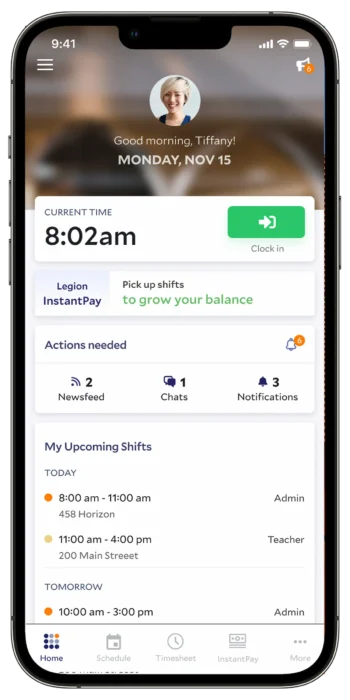
Ready for a Demo?
See how Legion's WFM Software enables intelligent automation to help you maximize labor efficiency and employee engagement simultaneously.

Cathy Hotka
CEO
Cathy Hotka & Associates

Michael Spataro
Chief Customer Officer
Legion Technologies

Ryan Holm
Dir. of Retail Innovation and Operations
Helzberg Diamonds