
“We are not Uber; we can’t bring people in to work 15 minutes at a time.”
That’s how one senior data analyst—at a retailer with more than 100,000 employees—described the staffing requirements produced by its legacy forecasting and labour-planning process. The system would call for five people in footwear, then jump to ten, then drop to two, all within the same hour. No manager could realistically staff against that.
This frustration isn’t unique to just one retailer. Volatile forecasts, schedules managers couldn’t trust, and hours spent fixing what the system produced came up again and again in conversations with workforce leaders.
Forrester Consulting interviewed four workforce leaders across retail and hospitality for a Total Economic Impact™ study of Legion Workforce Management. Their organisations ranged from a retail division with more than 1,600 employees to enterprises employing well over 100,000 people. Beyond the modeled ROI, the interviews revealed striking similarities in how the leaders described life before Legion.
Before Legion
“Store managers were spending 6 to 8 hours per week micromanaging both the current week and the future schedule,” the senior data analyst told Forrester. “They spent a lot of time in the back room instead of serving customers and were not very productive.”
Changing anything in the legacy system was an ordeal in itself. “It was like an act of Congress to get even something minor to happen,” the same interviewee said, describing a system so rigid that loading a weekly labour budget was, in their words, “a 4-hour process.”
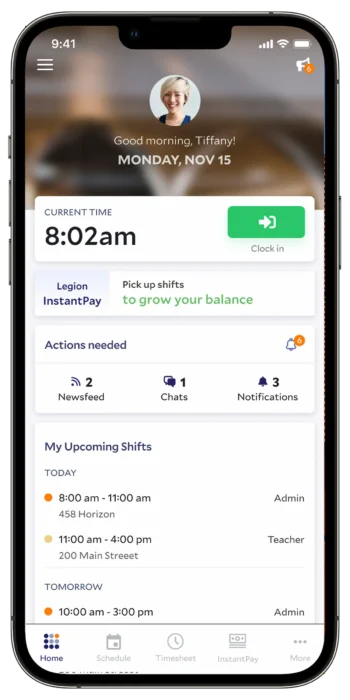
Employees weren’t better served by the old way either. Without a mobile app or self-service scheduling, employees had to call the store to view or change a shift and hope a manager could step away. A senior director of workforce management at another retail organisation put it plainly: “I can’t say enough about the efficiencies the mobile app created. To get their schedules, employees [used to have] to call stores and play the telephone game.”
When something went wrong on the compliance side—such as a missed meal break, a schedule changed too close to a shift in a market with predictive-scheduling rules—there often wasn’t a clean answer for why. “We had to pay the penalty because we had no reason to say why we wouldn’t every time a shift was altered,” the same interviewee said of the old system.
What changed
The change these interviewees described wasn’t the result of one feature. It came from demand forecasting, labour optimisation, automated scheduling, and employee self-service working together. More accurate forecasts and labour plans reduced the need for manual intervention. Automated scheduling then gave managers back hours previously spent building and adjusting schedules in the back room.
The data analyst whose team once couldn’t reliably staff footwear now runs 21,000 stores through a very different process: “We have 21,000 stores and we can generate those schedules in about two hours. We can change things quickly in the app and then regenerate them. Previously, it was a 24-hour process… It used to be done once a week and then it was hard to change. We have the ultimate flexibility with Legion, and it’s given us a huge time savings.”
Compliance visibility changed too, though it’s worth being precise about what that means: Legion automates attestations and calculations tied to scheduling and time-tracking rules, like meal-break and predictive-scheduling premiums, not an organisation’s full legal compliance program. One interviewee described the difference concretely: “Legion prompts them to attest whether they skipped a required break and, if so, whether that was at the employer’s request or their own choice… Now we have a digital record showing that we followed the law and paid the appropriate premiums.”
What it meant for people
The DVP of retail innovation and operations, who oversees a 1,600-plus-employee division, framed the payoff in terms of what schedule flexibility does for real people, not spreadsheets: “We experienced a 21% year-over-year reduction in turnover, which is huge. At least 10% of that reduction would belong to Legion. Being able to have your voice heard about your scheduling preferences with Legion has really made associates happy. The ability to get their schedule instantly on their phones and swap shifts is a really big deal to our employees.”
The same organisation achieved 92% adoption of the Legion mobile app among its hourly workforce and reported a 19% year-over-year reduction in absenteeism. Forrester identified both as additional benefits but did not assign them a financial value. At another organisation, peer-to-peer open-shift claiming, employees covering available shifts instead of managers scrambling to fill them, saved an estimated 1,900 hours of manager and administrative time in one year, as claim rates rose from 34% in 2023 to 58% in 2025.
These figures are individual customer outcomes, not results from the composite organisation used to calculate the headline ROI. They are included as supporting customer evidence and were not incorporated into the composite financial model.
What’s next
For some interviewees, the next chapter is Legion’s earned wage access capability. At the time of the interviews, it had not yet launched across most of their workforces. But one customer was already seeing considerable anticipation from employees.
“We’re getting ready to launch [Legion’s earned wage access solution], and we’ve already got associates that are over the moon excited about a product that hasn’t even launched yet. There’s a lot of goodwill toward Legion in our front lines.”
The impact will become clearer after rollout, but the response already says something important: employees notice when workforce technology is designed around their needs, not simply the organisation’s processes.
Read the full Forrester TEI study to explore the financial model and customer evidence behind these stories, or request a personalised value assessment for your organisation.
Related Articles



Want to Hear More From Legion?
Sign up to receive the latest industry research, expert-led webinars, and practical WFM resources.
Ready for a Demo?
See how Legion's WFM Software enables intelligent automation to help you maximise labour efficiency and employee engagement simultaneously.