
The conversation around the frontline workforce has been focused recently on labour shortages and increased costs. Two new studies from Legion outline that the more important questions for European business leaders are: Is the current workforce optimised to meet demand? Are employees empowered to contribute to the schedule based on their preferences?
Legion’s studies provide real evidence and numbers behind these challenges. Forrester’s 2026 Total Economic Impact™ study of the Legion Workforce Management platform was based on interviews with four customers. Forrester modelled a retailer with 15,000 employees and identified a 13x three-year ROI, with a $47.3 million NPV and payback in less than six months. In addition, The Frontline Workforce Index 2026, developed in conjunction with Retail Economics, surveyed 2,000 UK retail and hospitality employees and looked at the issue from another perspective: where workforce resilience is breaking down and what those weaknesses could cost businesses and workers.
Reading the reports together, the opportunity for businesses and the workforce is clear. Forrester demonstrates the business value of Legion’s Workforce Management platform and the financial benefits that can be realised. Retail Economics’ report outlines how much workforce capacity businesses are leaving unfulfilled and the availability and preferences employees want businesses to consider.
Are businesses correctly allocating labour hours?
Retail Economics’ Frontline Workforce Index scores the frontline worker experience at 65 out of 100, with Schedule Stability & Predictability the weakest pillar at 59. More than half of workers receive their final rota only two to three days before it starts, with 89% experiencing a shift being changed or cancelled with less than 48 hours’ notice. Only 18% describe their schedule as “very stable”.
It suggests many businesses are struggling to connect demand with available labour and employee preferences. This matters when around 320,000 workers are underemployed, which represents an approximate total of £3.6 billion annual earnings potential not being realised. Retail Economics estimates that around £0.9 billion of this could be accessed by reallocating hours from employees who want fewer to those who are in need of more.
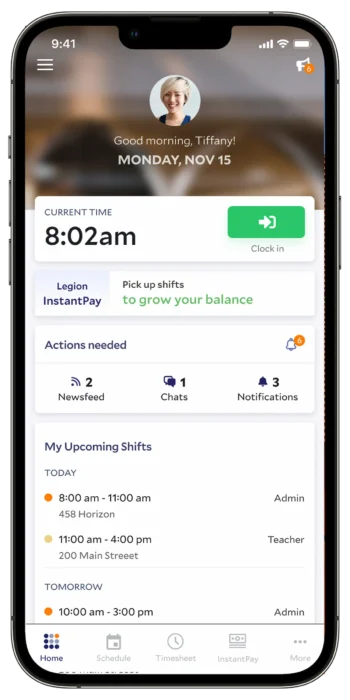
The Forrester study further supports this by illustrating what efficient labour allocation looks like in practice. A Senior Data Analyst at a Legion retail customer described how employees could offer their shifts or claim open shifts themselves, with managers still retaining approval. The customer’s open-shift claim rate substantially increased from 34% in 2023 to 58% in 2025. As the data analyst stated, the platform “gives employees more responsibility, makes them a bigger part of the scheduling process, and takes some of the burden off store managers”.
How does workforce scheduling affect employee retention?
The Frontline Workforce Index also estimates £6.7 billion replacement cost exposure if the identified retention risk is realised, consisting of £5.1 billion in training costs and £1.6 billion in lost efficiency. Therefore, even a 1% reduction in employee churn could save the industry around £102.4 million in training costs and £42.4 million in efficiency losses.
Some of that risk sits within the “Experienced Core”: employees with more than ten years in their industry. More than half of this group identified in the research are at risk across every UK region. When these employees leave, businesses lose more than frontline headcount. As the report identifies, “They lose familiarity with customers, routines, local peaks, systems and the informal ways teams absorb pressure”.
That is why retention, scheduling and productivity should be treated as interlocking frontline workforce challenges. Unstable schedules make work less attractive, disregarding employee preferences frustrates frontline workers, and the additional administration prevents managers from leading teams and engaging customers.
What is the ROI of workforce management software?
This is where the Forrester study adds important context for business leaders by quantifying the value of addressing these workforce challenges. In Forrester’s model, the retailer realised $50.8 million in three-year, risk-adjusted benefits against $3.5 million in costs. Scheduling optimisation contributed $21.1 million, reduced employee turnover $11.0 million, manager productivity $9.1 million, and avoided labour compliance penalties and legal exposure $7.8 million, with payroll and administration efficiencies contributing additional savings.
Better workforce management created value across scheduling, retention, manager productivity and compliance, rather than through one isolated cost lever. This is particularly clear in the manager productivity findings. A People Technology and Product Leader at a hospitality organisation told Forrester that scheduling time had fallen from around seven hours per week down to 3.5 hours. A Senior Director of Workforce Management at a retail organisation described the wider benefit: “The biggest win [for managers] is less time being in the office. Retail is won or lost on the shop floor”.
This is what traditional business cases for workforce technology often miss. The value of an hour saved is not the hour itself. It is what a manager can do with that time: coach employees, serve customers, solve operational issues and remain visible in the business.
Why is workforce optimisation important for European businesses?
The Frontline Workforce Index highlights the consequences of outdated workforce design: underutilised labour, unstable schedules, retention risk and lost operational knowledge. Forrester shows the economic value that can be created when scheduling, retention, productivity and compliance are addressed as a connected approach.
For one business, the biggest opportunity may be labour optimisation. For another, it could be retention, manager capacity or compliance. The answer will vary by organisation and market, but the principle is consistent.
Businesses that succeed in optimising their workforce will be those that make the best use of the people they already have: matching labour to demand, giving employees greater flexibility and freeing up managers to focus on the operation.
Join us for a briefing to explore what these findings could mean for your workforce, or request a value-based assessment for your own organisation, based on its unique priorities and operating environment.
The Forrester TEI findings are based on a composite North American organisation developed from interviews with Legion customers. Frontline Workforce Index findings are based on research among UK retail and hospitality employees. Individual results will vary.
Related Articles



Want to Hear More From Legion?
Sign up to receive the latest industry research, expert-led webinars, and practical WFM resources.
Ready for a Demo?
See how Legion's WFM Software enables intelligent automation to help you maximise labour efficiency and employee engagement simultaneously.