Labour Planning + Forecasting
Scheduling is Optimised. Planning Still Isn't.
Add Legion's Labour Planning and Forecasting on top of your existing workforce management software. Store-level reality in. Schedules that actually match the plan.

The Problem
Your Budget Reached Stores. Your Plan Didn't.
When planning and execution are disconnected, labour variance is inevitable. Most retailers report on labour, but they don't actually control it. Budgets drift by Week 3. Store overrides erode targets. Finance chases variance after month-end. The operating plan loses credibility before Q1 is even underway.
And it's not cheap. For a retailer with $50M in labour spend, even a 1–2% variance is $500K–$1M lost annually, often invisible until period close.
Annual budgets built top-down using headcount averages instead of operational reality
Forecasts that don't account for the demand signals actually driving the business: traffic, sales, local events, promotions, and weather
Labour planning modules that aggregate too coarsely to produce accurate, store-level operating plans in hours and dollars
Plans that live in spreadsheets and never reach store managers as actionable targets
Variances that surface at month-end when it’s too late to act
The Solution
The Intelligence Layer Behind Every Labour Decision.
Legion Forecasting uses AI to create custom models for each demand driver at every location, refreshed continuously as conditions change, and delivered at 15-minute intervals. That forecast feeds a bottom-up labour operating plan expressed in hours and dollars, built from real productivity standards and operational constraints.
Your existing WFM platform then schedules against targets grounded in what each location actually needs.
Forecasting at 15-minute intervals, in production today
Bottom-up labour plans built from granular labour standards, not aggregated estimates
Scenario modeling for wage, volume, and productivity shifts before you commit
Continuous reforecasting that catches variance before period close
Plans flow directly into your existing scheduling workflow as operational guardrails
Two Ways to Start
Two Ways to Add Legion. Pick What Your Business Needs.
Option 1
Labour Planning on Top of Your Existing WFM
Your scheduling platform works. Your labour plan doesn't.
Who it's for
- Your labour budgets are built top-down and miss local needs
- Planning and scheduling are disconnected
- Variances show up too late to act on them
- Finance and Operations aren’t aligned
- You need improved labour control without disrupting scheduling operations
What you get
- Demand-driven labour plans built from real operational data
- Labour targets enforced directly in scheduling
- Real-time visibility into labour variance
- One shared plan for Finance and Operations
- Continuous reforecasting as conditions change

Option 2
Labour Planning + Demand Forecasting over your WFM
Who it's for
- Forecast accuracy challenges
- Recurring labour variance
- Inconsistent regional execution
- Disconnected Finance and Operations teams
- Labour plans that need to react faster to changing demand
What You Get
- More accurate forecasts
- Demand-aligned labour plans
- Reduced labour variance
- Greater labour efficiency
- Share Finance and Operations visibility
- Faster response to demand shifts and events


Granular Labour Standards
The More Granular the Plan, the Less Variance You Chase
Most labour models plan at the job level, applying broad adjustments when demand changes. Legion plans at the task level, scanning, till management, cleaning, restocking, and more, each with its own labour standard. Labour plans are built around the productivity standards and operational constraints that reflect how work actually gets done at each location.
When conditions change, Legion adjusts labour where the change is occurring. A 10-hour reduction, for example, is distributed across tasks rather than absorbed through arbitrary shift cuts. Granular in. Accurate out. Every planning, scheduling, and execution decision benefits from that precision.
Forecasting in Production Today
Why Settle for Quarterly Forecasts When Demand Changes Weekly?
Most retail forecasts are built quarterly and begin aging the moment they're delivered. They don't react to local demand shifts or account for factors such as a local event driving traffic at one location but not another nearby store. By the time the forecast reaches scheduling, conditions have already changed.
Legion AI builds and continuously refreshes models based on the drivers that actually move labour at each location: traffic, sales, productivity, weather, and events. Every forecast includes key drivers and confidence intervals, helping managers understand not just what will happen, but why. Better forecasts create better plans and better schedules.


Finance and Operations on the Same Plane
Why Settle for Two Versions of the Labour Truth?
Finance builds a plan. Operations executes a schedule. They live in different systems, sometimes different tools entirely. The variance between them is where labour cost and credibility leak away.
Legion connects Finance and Operations through a single, defensible labour plan. With versioning, audit trails, role-based access, and real-time variance monitoring, every approved adjustment is visible, and every override is governed. This isn’t after-the-fact reporting. It’s active labour control.
It's not a planning tool. It's a control system for labour.
Where Legion Fits in Your Stack
Your WFM Keeps Doing Its Job. Legion Makes Every Labour Decision Smarter Behind It.
Add Legion as the operational intelligence layer behind the platform you already run. No replacement. No disruption. No new system for your store teams to learn.
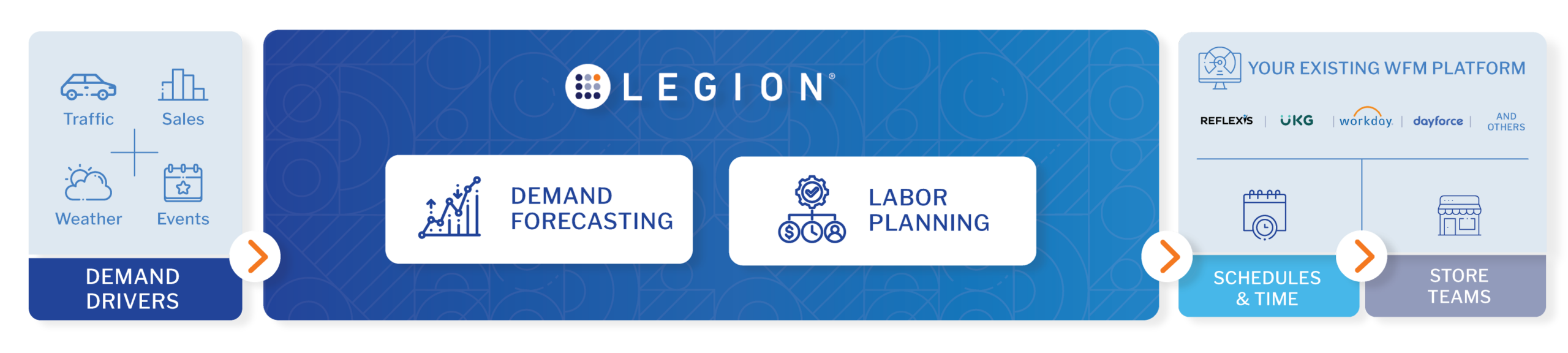
- Legion forecasts demand, so your WFM doesn't have to
- Legion builds the labour plan, and your scheduling engine runs against it
- Store teams continue using the WFM interface they already know
- Finance and Operations see one plan, one truth, one source of variance, in real time
Legion by the Numbers
Legion Labour Planning
13x
ROI, proven with Legion WFM
28%
schedule fit for employees and business needs
0.5%
reduction in labour costs for every 1% improvement in demand forecast accuracy
1.6B
data points forecasted weekly with Legion AI
Learn More About Legion



FAQ
Legion Labour Planning
Add the Layer Your WFM Is Missing
See Legion's Labour Planning and Demand Forecasting working alongside your existing platform in a personalised 30-minute demo.