
Profit margin is the percentage of revenue your business keeps as profit. The formula is simple: subtract cost from revenue, divide by revenue, and multiply by 100. But most frontline operators, even when their margins are tight, can't tell you exactly what their margins are or which type of margin matters most.
There are three types of profit margins: gross profit margins, operating profit margins, and net profit margins. Each tells you something different about where costs are showing up in business. And for frontline organisations, labour costs are one of the few levers that move them all.
Types of Profit Margin and Their Formulas
Each type of margin gives you a different view of business performance. Understanding the differences between the margin types helps you spot where to cut costs and protect profitability.
How to calculate profit margin percentage:
(Revenue – Total Costs) ÷ Revenue × 100 = Profit Margin %
Here's what each type tells you:
- Gross Profit Margin: How much profit remains after you pay for products
- Operating Profit Margin: How much profit remains after day-to-day costs, including payroll
- Net Profit Margin: Your true bottom-line profit after every cost, including taxes and interest.
Gross Profit Margin
Gross profit margin shows profitability after you pay for the goods you sell, but before operating costs like payroll, rent, and utilities.
How to calculate gross profit margin:
(Revenue – Cost of Goods Sold) ÷ Revenue × 100
Why it matters: This is your starting point. If gross margins are low, the problem is with your product costs or pricing, not overhead.
For example, if a restaurant spends $1,000 in food and generates $2,500 in sales, the gross margin is 60%.
Operating Profit Margin
Operating profit margin includes products, payroll, rent, utilities, and other day-to-day operating costs, but not taxes or interest.
How to calculate operating profit margin:
(Operating profit ÷ Revenue) × 100
Why it matters: It shows whether your core business model is profitable before financial obligations. This is where labour cost has the biggest impact. A manager who overstaffs shifts or misses the labour budget will see the operating margin drop quickly.
Net Profit Margin
Net profit margin is the bottom line. It includes all costs, including taxes, interest, and debt payments. This is your true profit after everything.
How to calculate net profit margin:
(Net Income ÷ Revenue) × 100
Why it matters: This is what investors and lenders care about, and labour costs are a deciding factor. According to the National Restaurant Association, labour costs accounted for almost 50% of every sales dollar for full-service restaurants that reported a loss.
Profit Margin by Industry
What's "good" depends on your business type. Retail, restaurants, and hospitality all carry different cost structures.
Restaurant profit margins typically fall between 3% and 9% of revenue, depending on restaurant type. For example, fast-food restaurants see a 6%–9% profit margin because they benefit from higher customer volume and standardized food preparation. For other types of restaurants, 5% is a good profit margin to aim for.
Retail profit margins vary widely by category, with an average of 2%-10%. Online stores don’t incur rent costs, so margins are higher. And specialty stores earn more profit per item than discount or grocery stores.
Hospitality profit margins are healthy at 10%. 5% is considered low, and 20% is considered high. The range varies by location, seasonality, and occupancy rates.
Labour Cost and Profit Margin
Labour cost is unique because it's both predictable and variable. You can forecast staffing needs and control scheduling. But many managers treat labour as a fixed cost and react to demand rather than plan for it.
When you overstaff a shift, you're burning profit directly. Overstaffing a restaurant by just two employees on a slow Tuesday can cost thousands per month. Conversely, understaffing creates hidden costs: missed sales, poor customer experience, burnout, and turnover.
This is why demand forecasting and labour scheduling are so critical. Demand forecasting lets you predict customer traffic and schedule the right number of staff for each shift. When you match staffing to real demand:
- Labour percentage drops
- Operating margin improves
- Net margin becomes easier to protect
The most profitable operators in retail and other hourly industries realise that labour scheduling is a profit margin strategy, not just a compliance task.
How to Measure & Improve Profit Margin in Shift-Based Businesses
Getting profit margin right starts with measurement. Here's how to build a system that actually works, and which tools can help.
- Establish your baseline: Calculate your actual labour percentage monthly. Take the total labour costs (wages, benefits, payroll taxes) and divide by revenue. This gives you a clear baseline for how much of each sales dollar is going to labour.
- Analyse by location: Not every location operates the same way. A flagship store and a secondary location can have different margin profiles. Track margin by unit to identify which locations are operating efficiently.
- Connect scheduling to margin targets: Once you know your target labour percentage, use it to guide scheduling decisions. If you're at 35% and need to hit 30%, you know how many labour hours you have to work with each week.
Tools that help you measure and act:
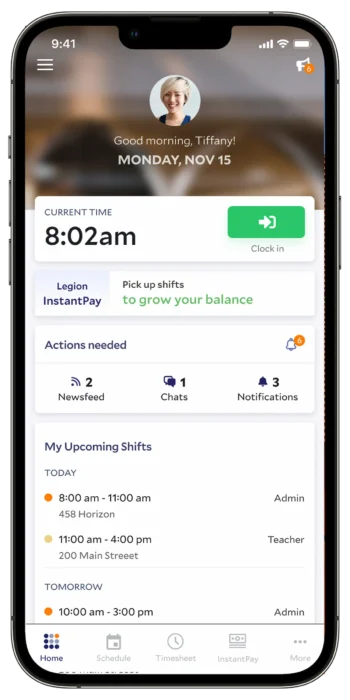
- Workforce management platforms: Platforms like Legion Workforce Management integrate scheduling, time tracking, and labour cost visibility into one system. That makes it easier to see real-time labour spend against budget and helps you instantly see the profit margin impact of scheduling decisions.
- Demand forecasting and scheduling optimisation software: Forecasting and scheduling tools use historical data and AI to predict staffing needs and automatically calculate labour budgets. This solves the core problem, matching labour hours to demand rather than guessing.
- Manual dashboards and spreadsheets: Manual calculation can work if you're disciplined about weekly updates. Pull data from payroll and POS, calculate labour percentage, and track it against targets. It's slower than automated tools and doesn’t scale, but it works for single-location operators.
Many of these tools depend heavily on clean data and on directly connecting data to the platform to produce custom reports that provide insights into your business’s specific use cases.
Without clean data and customization, measuring profit margins and applying those insights to hourly staff planning can be challenging.
The Profit Margin Reality for Hourly Businesses
Profit margin pressure is real, but operators who win aren't dramatically cutting costs. They're automating away complexity and making smarter labour decisions.
When you implement a structured approach to labour planning, your labour costs come down naturally, and your profit margin increases.
FAQs
What is a good profit margin for a restaurant?
What's the difference between gross margin and net margin?
How does scheduling impact profit margin?
What is SPLH, and how does it relate to profit margin?
Related Articles



Want to Hear More From Legion?
Sign up to receive the latest industry research, expert-led webinars, and practical WFM resources.
Ready for a Demo?
See how Legion's WFM Software enables intelligent automation to help you maximise labour efficiency and employee engagement simultaneously.