
Workforce management optimisation helps organisations align labour with demand to improve productivity, control costs, and increase agility. It enables businesses with large frontline workforces to make more informed staffing decisions across locations, roles, and shifts. Done well, it reduces labour waste and helps teams respond faster to changing business conditions.
Managing a workforce means assigning tasks and filling shifts. Optimising it goes further—balancing every labour hour for maximum impact while boosting employee engagement. At its core, optimisation means aligning business needs with employee skills and preferences, creating a win-win that simultaneously maximises both labour efficiency and employee engagement. True optimisation leverages data and automation to improve productivity, reduce costs, and enhance agility.
In today’s volatile labour landscape, legacy workforce management (WFM) methods, such as manual spreadsheets, rigid schedules, and one-size-fits-all policies, simply can’t keep up. Businesses need actionable, real-time strategies that adapt to shifting demand, employee needs, and operational complexity. Here are proven workforce optimisation strategies that deliver results.
What Is Workforce Optimisation and Why Does It Matter for Hourly Employees?
Workforce optimisation (WFO) is the practice of improving how labour is planned, scheduled, managed, and supported, enabling businesses to operate more efficiently while creating a better day-to-day experience for employees. This matters because labour decisions directly shape schedule quality, shift access, manager workload, compliance exposure, and payroll accuracy. Legion consistently ties optimisation to both business performance and employee engagement, not one at the expense of the other.
For hourly employees, effective workforce optimisation means more predictable schedules, greater flexibility, easier shift swaps and self-service, better communication, and faster access to earned wages when available. For enterprise leaders across retail, hospitality, restaurants, distribution, and other labour-intensive sectors, it creates tighter control over labour costs, stronger compliance, better coverage, and more consistent execution across locations.
Key components of workforce optimisation include:
- Accurate forecasting to better anticipate labour needs by location, role, and time period
- Labour planning to translate demand, productivity assumptions, and financial targets into practical staffing plans
- Optimised scheduling to align coverage with business needs, employee availability, and compliance requirements
- Stronger time and attendance processes to improve payroll accuracy, reduce manual corrections, and support compliance
- Greater employee flexibility and autonomy so workers can more easily manage shifts, availability, and time-off requests
- Clear frontline communication to keep employees informed, connected, and aligned
Benefits of Workforce Optimisation
Workforce optimisation helps businesses align labour more closely to real demand across stores, channels, promotions, local events, and peak trading periods. The result is better coverage when and where it matters, with less overstaffing, less understaffing, and more consistent execution on the floor.
It also improves manager productivity by reducing the manual workload required to build schedules, adjust coverage, and respond to change. With better forecasting, bottom-up labour planning, and automated scheduling, managers spend less time on administration and more time supporting teams and delivering a greater customer experience.
For retailers with a large workforce, workforce optimisation also creates a more agile operating model. It helps organisations respond faster to demand volatility, protect margins, and make better use of every labour hour without losing sight of the employee experience. It becomes a lever for productivity, service quality, and retention.
Examples of Workforce Optimisation Strategies
The most effective workforce optimisation strategies use data to drive every decision, from how many workers are needed to who gets scheduled at what time. Below are four tactics that deliver measurable improvements across labour efficiency, engagement, and cost control.
Use Labour Forecasting Tools to Align Staffing with Demand
Labour forecasting tools leverage historical trends, real-time data, internal factors like sales and promotions, and external signals such as weather, holidays, and local events to predict future staffing needs accurately. By analysing thousands of data points—from past performance to ongoing operations and upcoming events—this data-driven precision ensures that employee schedules closely align with actual demand, enabling more efficient staffing and improved operational performance.
Companies using Legion’s advanced forecasting techniques usually see a noticeable 0.5% reduction in labour costs for every 1% improvement in forecasting accuracy, along with higher customer satisfaction.
Automate and Personalise Scheduling
Static scheduling models are inefficient in dynamic environments. Legion Scheduling engines can automatically generate shift plans in minutes rather than hours based on forecasted demand, employee skills, and availability.
Personalised schedules that consider individual preferences improve shift performance, help maintain compliance, and reduce absenteeism. Research from Gartner shows that businesses adopting automated scheduling experience 25% less unplanned absenteeism. Automation also eliminates bias and reduces the burden on frontline managers.
Give Employees More Control Over Their Schedules
Flexible scheduling isn’t just a perk; it’s a major driver of employee retention. According to Legion’s 2025 State of the North American Hourly Workforce report, 61% of hourly workers say the ability to choose when they work is among the most important factors when looking for hourly work.
Self-service scheduling tools—such as shift swaps, on-demand shift claims, and flexible work preferences—directly address these priorities. They give employees greater control over their schedules, reduce friction with managers, and strengthen long-term engagement.
When employees have more control, they’re more likely to stay and perform. Empowered teams are better aligned with business goals, and frontline managers can spend less time fixing coverage gaps and more time developing their teams.
Track and Adjust in Real Time
The best plans are still subject to change. Real-time labour visibility allows businesses to adjust on the fly—reallocating labour, adjusting shifts, and responding to unexpected callouts or demand spikes.
Live insights into performance, coverage, and compliance give managers the information they need to make smarter weekly decisions. This reduces unproductive hours and helps maintain alignment with budget and business goals.
How to Implement WFO Strategies
Workforce optimisation is most effective when organisations start with a clear business problem, then apply the right mix of forecasting, planning, scheduling, and employee experience improvements to solve it.
Common ways to implement workforce optimisation include:
- Improve forecasting when demand is highly variable across stores, seasons, promotions, or peak periods.
- Automate scheduling when managers spend too much time building and adjusting schedules manually.
- Connect labour plans to execution when budgets and store-level labour decisions are falling out of sync.
- Enable self-service and shift flexibility to address ongoing challenges in filling shifts, responsiveness, and retention.
- Modernise time and attendance workflows when payroll errors, compliance risks, or manager admin time create friction.
For example, a retailer might begin by improving forecast accuracy in high-variance locations, then introduce more automated scheduling to better align labour with demand. Another may start by giving employees better shift self-service and communication tools to improve fill rates, flexibility, and retention before expanding into broader optimisation.
How Legion Brings These Strategies to Life
Legion’s workforce optimisation platform operationalizes all of these strategies in one integrated system:
- Labour Forecasting: Uses historical trends and external signals to deliver a highly accurate and auto-generated unique model and forecast for every driver. It forecasts demand in 15-minute, 30-minute, or daily increments while customised advanced machine learning algorithms continually improve and learn from the data.
- Labour Optimisation: Brings together labour and schedule optimisation into a unified approach, ensuring labour is planned and executed with precision. It considers all labour-related elements, including models and location-specific attributes, to optimise labour demand, not just the schedule. Legion automatically generates granular, down-to-the-minute, task-based labour plans across all channels while balancing preferences, availability, skills, productivity, budgets, and compliance. It then instantly translates these plans into optimised schedules, ensuring the right people are in the right place at the right time. The result is schedules that meet business needs and employee preferences 96% of the time.
- Employee Productivity-Based Scheduling: Seamlessly integrates employee productivity into scheduling without compromising other critical business needs (e.g., budgets, compliance, or employee preferences). It uses calculated employee productivity scores to optimise schedules with top performers working at critical times, ensuring managers have the staffing and performance to meet sales and output targets.
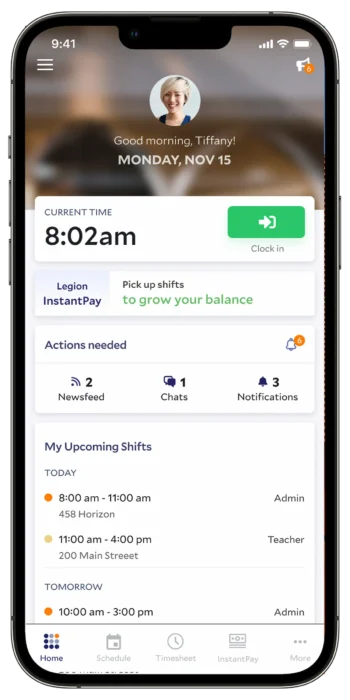
- Employee Engagement Trifecta: Through a 4.9-star-rated mobile app with 88% weekly active usage, Legion delivers Schedule Empowerment, Workforce Self-Service, and On-Demand Pay in a single experience. Employees can set availability, swap and claim shifts in real time, communicate with managers and peers, and access earned wages when needed. Together, these capabilities drive an average 33% improvement in retention, while increasing engagement, improving shift uptake, and creating a more reliable workforce.
- Real-World Results: Legion customers have reported up to 13x ROI, a 25% reduction in labour overages, and up to 5 hours saved weekly per manager.
Workforce Optimisation Is the New Standard
Workforce optimisation is quickly becoming a competitive requirement for an hourly workforce. Efficiency, productivity, and employee satisfaction are no longer tradeoffs; they are critical goals that must be achieved simultaneously.
That’s why businesses need tools that go beyond reporting data and actually act on it. Legion enables organisations to optimise labour in real time, at scale, across every location and role.
Ready to turn strategy into action? Request a demo and see what optimisation really looks like.
Workforce Management Optimisation FAQs
What is the most effective workforce optimisation strategy for reducing labour costs?
How do you balance labour supply with fluctuating demand?
What does a workforce optimisation strategy look like in retail?
How does automated scheduling improve frontline productivity?
What's the difference between workforce management and workforce optimisation?
Related Articles



Want to Hear More From Legion?
Sign up to receive the latest industry research, expert-led webinars, and practical WFM resources.
Ready for a Demo?
See how Legion's WFM Software enables intelligent automation to help you maximise labour efficiency and employee engagement simultaneously.